
Introduction:
The book Spirituality in art Wassily Kandinsky’s The Art of the Spirit is a pillar of modern artistic thought, asserting that art has a unique ability to transcend the material world and touch deep spiritual dimensions. For Kandinsky, the artist is a mediator between the visible and invisible realms, using color, form, and composition to express the invisible. His belief that art can communicate the spiritual resonates across time, inviting us to consider its relevance in contemporary society.
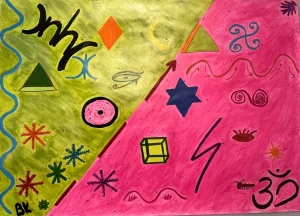
Reflecting on Kandinsky’s visionary ideas, I believe deeply that art still holds the power to save the world. Art has the ability to create bridges between our current dimension and higher realities, dimensions that can elevate the human experience. Through art, we can ascend to new states of consciousness and understanding. As Kandinsky envisioned, the role of the artist is not simply to represent the visible world, but to create a spiritual connection between the viewer and something transcendent. The true potential of art lies in its ability to speak through color, form, and space—expressing nuances, ideas, and feelings that words can never fully capture.
Complete Narcissism Release — PDF book
[wptb id=5166]
1. Spirituality as a Creative Force: Kandinsky’s Vision
Kandinsky’s call for the artist to create beyond the material world resonates deeply with the idea that art can be a conduit to higher dimensions. He proposed that the true purpose of art was to express the “inner world” – a world that exists beyond the tangible, where emotions and ideas merge into a spiritual language of color, form and composition.
- Art as a Bridge to the Spiritual: Just as Kandinsky emphasized the role of the artist in accessing and expressing universal truths, I believe that painting has a unique capacity to create bridges to higher dimensions. Through the conscious manipulation of the color, the shade, the form and the composition, art can speak a language that connects us to higher realms of existence. Painting’s ability to capture the subtleties of experience—the complex interplay of light, shadow, color, and texture—allows it to convey meanings that transcend ordinary language. Art does not simply represent the world; it processes the viewer’s perception, creating a deeper understanding that goes beyond what is immediately visible.
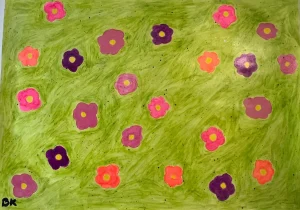
- The Power of Color and Shape: A painting, when done with intention, can convey complex emotional and spiritual states. The mix of colors and forms in a composition has the power to evoke a whole range of human experiences. It speaks to something deep within us, establishing a connection between the artist’s inner world and the viewer’s soul. This idea of mixing shapes and colors – and letting them harmonize freely – reminds us of the fluidity between the material and spiritual worlds. Just as Kandinsky used color and form to access the inner dimension, so the contemporary artist creates works that resonate with us on multiple levels, guiding us toward a higher understanding.
2. The Role of the Artist in the Transmission of the Spiritual
Kandinsky considered the artist not only as a creator, but also as a spiritual channel, capable of expressing the invisible truths that lie beneath the surface of reality. The work of art is therefore not only a matter of aesthetics or technique, it is a deep expression of the soul’s needs and desires.
- Art as a Vision of the Future: True art, in my view, is already situated in the future. It transcends the limits of its time and begins to speak the language of tomorrow. Art that merely represents its time—art that merely reflects the material world as it is—is already dead. Truly transformative art comes from a internal need, from the artist’s deep desire to communicate a vision that has not yet found its place in the world. However, this vision will one day manifest itself, because the artist’s work influences and transforms the material world. Like the Bauhaus movement, art has the ability to reshape entire societies. The Bauhaus not only transformed architecture and design, but also influenced the way people thought about space, functionality, and aesthetics. Great art is not simply an expression of its time; it creates a blueprint for what is to come.
- The Role of the Visionary Artist: The role of the artist is to channel a higher vision, which speaks not only to the present but also to the future. Art is a Vision which serves as a prelude to material reality. It can open up new ways of thinking and being, ways that will then shape the physical world. The artist, in this sense, is a prophet, revealing a glimpse of a reality that will take shape through the collective influence of art on the human psyche.
3. Contemporary Art and the Continued Relevance of Spirituality
Although much has changed since Kandinsky’s time, the spiritual dimension of art remains more relevant than ever. In the contemporary world, dominated by technological innovation and materialism, one could say that art is even more necessary to revive the spiritual in us. Art allows us to access dimensions of consciousness often obscured by technology and mass consumption.
- Art as a Path to Ascension: If we seek to ascend to higher dimensions, we must create bridges between our current reality and higher states of consciousness. Art, especially abstract and experimental art, allows us to transcend the limitations of everyday life and enter a deeper realm of being. When we look at a work of art—whether abstract, conceptual, or even digital—we are invited to explore new ways of perceiving the world. These new experiences are like portes to higher dimensions, creating paths through which we can begin to ascend in consciousness.
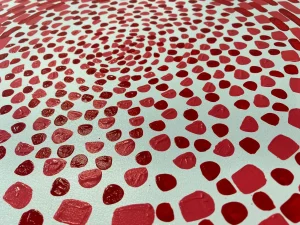
- Art and Healing: As an artist, I deeply believe in the healing power of art. Through my collection Soul Paths and Portals, I create works that act as gateways to higher dimensions, inviting viewers to embark on a transformative journey. Each painting is designed to be a portal, a space where the soul can reconnect with its deeper self and release stored energies. The more one meditates on these works, the more they open the door to healing, allowing old wounds, emotional blocks, and stagnant energies to dissipate. For me, art is not just an aesthetic expression—it is a tool for spiritual growth and emotional release. The paintings serve as a mirror to the soul, helping each individual access higher states of consciousness and promote inner harmony. You can explore my work and connect with this healing energy on my Instagram.
4. Reinventing the Spiritual in the Digital Age
In the age of digital media and virtual realities, it is clear that art continues to evolve and its ability to bridge dimensions is being explored in new and innovative ways. Digital artists and creators are finding that virtual environments offer new opportunities to express the spiritual through immersive and interactive experiences.
- Art in the Virtual Domain: The digital world, like traditional media, has the ability to convey transcendent experiences. The immersive nature of virtual reality (VR) allows artists to create worlds that seem expansive and limitless, realms where the viewer can experience a sense of spiritual elevation. It’s not just about aesthetics; it’s about creating an environment that facilitates a spiritual encounter. When Kandinsky spoke of art as a language of the soul, he was likely anticipating the kinds of sensory experiences now possible through digital art and VR, which have the ability to evoke deep emotional and spiritual responses.
- Art and Collective Consciousness: Just as previous movements, such as the Bauhaus, had a profound impact on the social and architectural landscape, the digital age allows artists to shape the collective consciousness in new ways. Through digital media, art can create spaces where new ideas—whether spiritual, philosophical, or existential—are incubated and given form.
Complete Narcissism Release — PDF book
A personal workbook about your voice, boundaries and relationship with yourself. Explore the contents and available languages.